
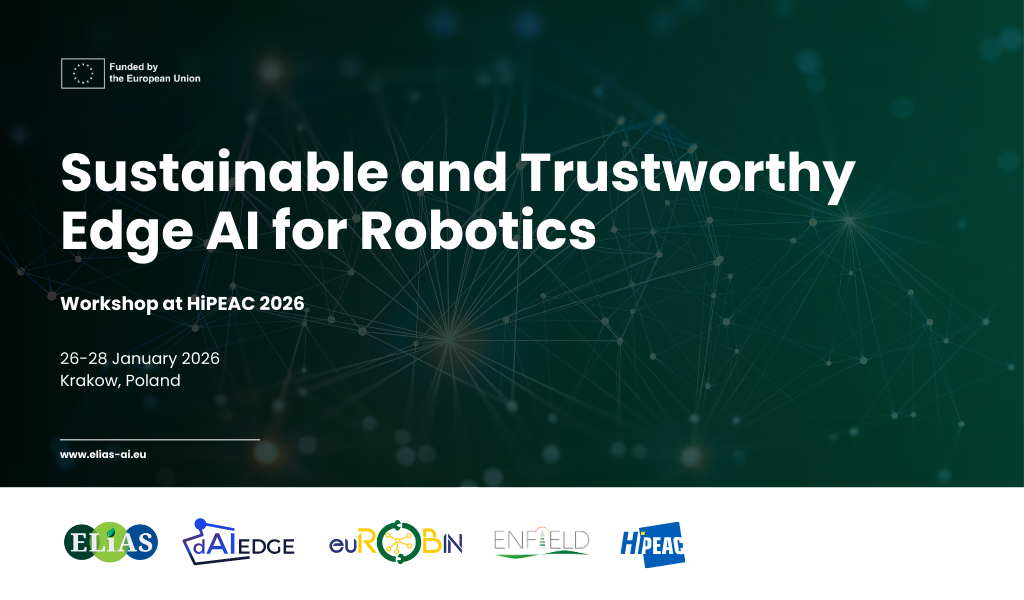
Edge AI and robotics are increasingly integrated in real-world systems that demand low-latency inference, efficient computation, and robust autonomy. However, deploying AI at the edge brings unique challenges, including limited computational resources, evolving regulatory constraints, and the need for trustworthy, safe, and explainable models
As Europe advances toward sovereign, human-centric AI systems, new approaches are required to ensure that intelligent agents operating at the edge remain reliable, sustainable, and aligned with ethical and legal frameworks such as the AI Act.
This workshop brings together researchers from Edge AI, embedded learning, and robotics to explore the intersection of technical design and responsible deployment. It focuses on architectures and methods that enable privacy-preserving, bias-aware, and energy-efficient AI at the edge, while ensuring adaptability and safety in robotic applications.
The event is jointly organized by four EU-funded Networks of Excellence (NoEs) – dAIEDGE, euROBIN, ELIAS, and ENFIELD – and aims to foster collaboration across these initiatives and the broader HiPEAC community.
More information can also be found here.
Workshop Structure

Invited Keynote Talks

Paper Presentations: peer-reviewed contribution from academia and industry

Panel Discussion: addressing challenges and future directions in Edge AI for Robotics
Important Dates
Paper submission deadline
Notification to authors
December 23, 2025
Workshop date
January 28, 2026
Call for Papers (CfP)
We invite submissions on (but not limited to) the following topics:
Architectures and Frameworks for Edge AI
- Distributed and hierarchical AI architectures for robotic systems
- Edge–cloud continuum design and orchestration
- Lightweight neural networks and model compression for embedded devices
- Hardware-aware AI acceleration (FPGA, RISC-V, neuromorphic, etc.)
- Real-time inference and scheduling for autonomous robots
Trustworthy and Explainable Edge Intelligence
- Explainable and interpretable AI for robotic decision-making
- Uncertainty estimation and safety assurance for edge perception and control
- Robustness against adversarial conditions and sensor noise
- Verification, validation, and certification of AI components at the edge
- Compliance with EU regulatory frameworks (e.g., AI Act, Ethics Guidelines)
Sustainable and Energy-Efficient AI
- Low-power AI computation and green optimization techniques
- Energy-aware learning and adaptive workloads for embedded systems
- Sustainable lifecycle management of AI models and hardware
- Metrics and benchmarks for energy efficiency in edge robotics
Learning and Adaptation at the Edge
- Continual, federated, and transfer learning for robotics
- On-device and online learning strategies
- Adaptive multi-modal perception for dynamic environments
- Collaborative intelligence among distributed robotic agents
Applications and Use Cases
- Edge-enabled robotics for manufacturing, logistics, healthcare, and agriculture
- Human–robot interaction and shared autonomy
- Swarm and multi-robot coordination using distributed intelligence
- Trustworthy AI for inspection, maintenance, and environmental monitoring
Cross-Cutting Themes
- Open datasets, benchmarks, and reproducible research for edge robotics
- Security, privacy, and data governance in edge–robotic ecosystems
- Integration of large or foundation models at the edge
- Socio-technical, ethical, and legal dimensions of autonomous systems
Submissions
Papers will be reviewed by the workshop’s technical program committee according to criteria regarding a submission’s quality, relevance to the workshop’s topics, and, foremost, its potential to spark discussions about directions, insights, and solutions on the topics mentioned above. Research papers, case studies, position papers and work-in-progress are all welcome. Papers should be in double column IEEE format of between 4 and 8 pages including references. Papers should be uploaded as PDF and not anonymized. At least one of the authors must register at the conference and attend the workshop to present the paper if it is accepted. Please note that there will be no proceedings. Authors will retain all rights to submit the work elsewhere. With the explicit permission of the authors, accepted papers will be posted on the workshop website prior to the event.

Organisers
Cecilia Zanazzo, Università di Trento (UNITN); Georgios Kavallieratos, Norwegian University of Science and Technology (NTNU); Lydia Belkadi, KU Leuven (KUL); Mohamed Selim, German Research Center for Artificial Intelligence (DFKI); Rebecca Schedl-Warpup, German Aerospace Center (DLR).
About HiPEAC 2026
The HiPEAC conference is the premier European forum for experts in computer architecture, programming models, compilers and operating systems for general-purpose, embedded and cyber-physical systems. Areas of focus and integration include safety-critical dependencies, cybersecurity, energy efficiency and machine learning. The HiPEAC 2026 conference will take place in Kraków, Poland. Associated workshops, tutorials, special sessions, several large poster session and an industrial exhibition will run in parallel with the conference.