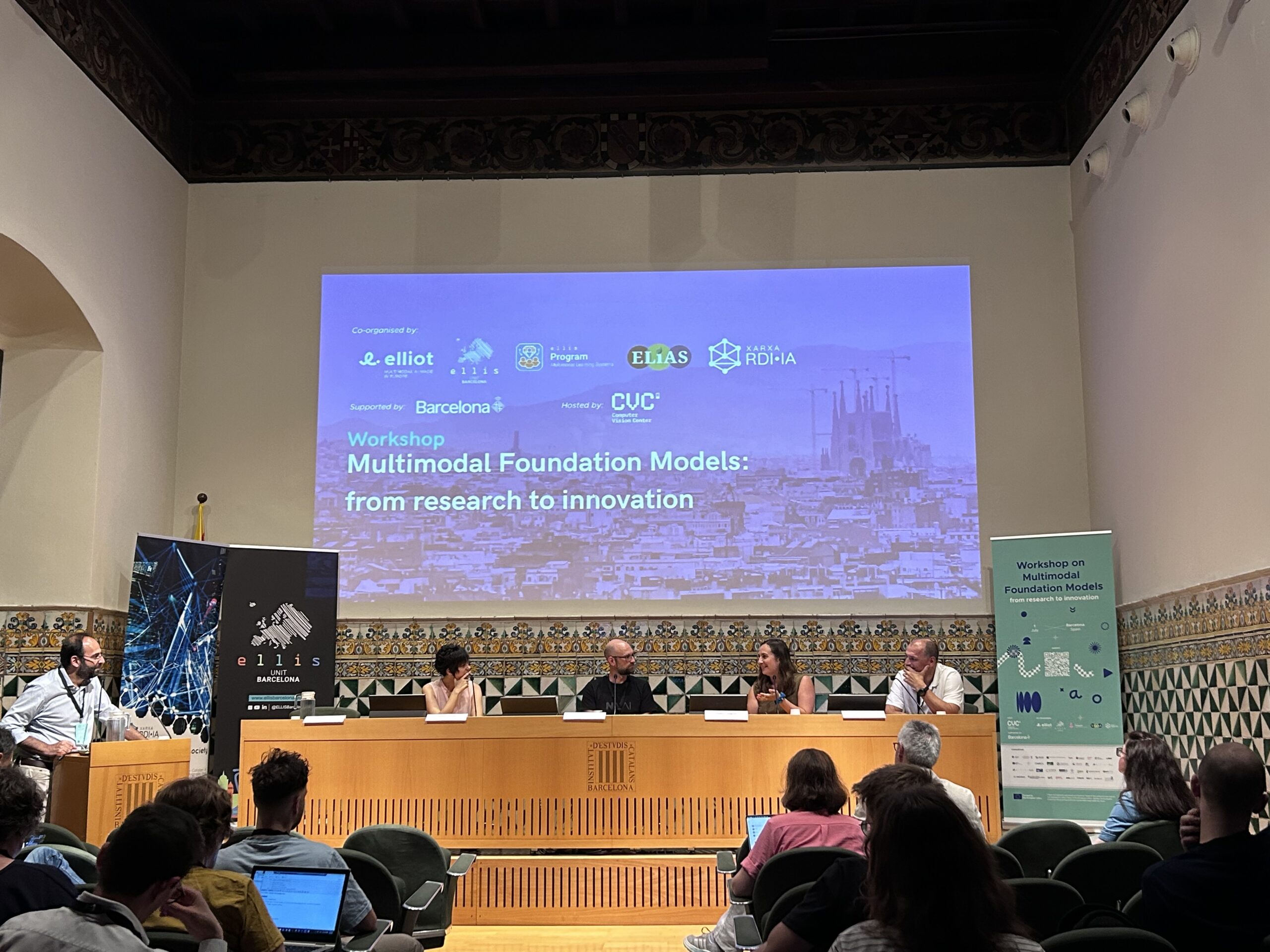
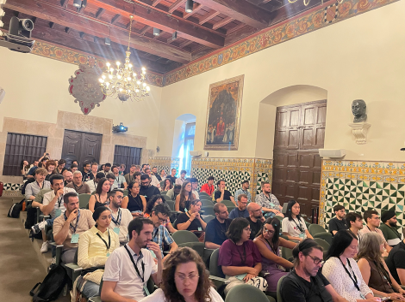
On 1 July 2026, ELIAS co-organised the workshop “Multimodal Foundation Models: From Research to Innovation” at the Institut d’Estudis Catalans in Barcelona, bringing together nearly 150 on-site participants and 100 livestream viewers. The event provided a platform to explore how open, sovereign, and trustworthy multimodal AI models can transition from frontier academic research into real-world applications across Europe.
The event is hosted by the Computer Vision Center (CVC), co-organised by ELIAS, ELLIOT, ELLIS Unit Barcelona, the ELLIS Programme on Multimodal Learning Systems, ELIAS, and XARXA RDI-IA, and supported by the city council of Barcelona.
Frontier Research & Technical Advances
The morning sessions delivered deep dives into the capabilities of multimodal systems—from egocentric perception to efficient model architectures:
-
Human Behaviour Analysis: Prof. Ioannis Patras (QMUL / Tavus) presented multimodal adaptation and generation techniques for digital humans combining voice, facial dynamics, and emotional intelligence.
-
Egocentric World Modelling: Prof. Dima Damen (University of Bristol / Google DeepMind) discussed action understanding and object interactions from wearable sensor streams, leveraging benchmarks like EPIC-KITCHENS.
-
Model Merging: Dr Joost van de Weijer (CVC) introduced training-free methods to combine task-specific models into single multi-task foundation models.
-
Robot World Models: Jai Bardhan (CIIRC CTU Prague) showcased how pretrained video diffusion models serve as data-driven alternatives to simulators for robotic planning and policy evaluation.
-
Medical Diagnostic AI: Prof. Vittorio Murino (University of Verona / IIT) demonstrated few-shot adaptations of CLIP for image- and pixel-level anomaly segmentation across medical imaging modalities.
Translating Science into Innovation
Industry applications took centre stage with an invited presentation by Eric Verdaguer (CEO of LogMeal), who detailed how computer vision and depth-sensing AI are deployed in healthcare settings to monitor hospital nutrition and reduce food waste.
A dedicated panel on commercialising frontier AI—moderated by Prof. Dimosthenis Karatzas (CVC / ELLIS Barcelona)—featured insights from Jordina Torrents (HP Inc. AI Lab), Isabelle Siegrist (Sandborn / ETH AI Center), Lukas Fischer (NXAI), and Eric Verdaguer. The discussion highlighted strategies for bridging technical research with enterprise needs, venture creation, and trustable deployment.
Strengthening Europe’s AI Network
Featuring opening and closing remarks from Javier Selva and Rafael González (Department of Research and Universities, Government of Catalonia), the workshop emphasised Barcelona’s role as a major hub for AI transfer.
Hosted by the Computer Vision Center (CVC), the workshop was co-organised by ELIAS alongside ELLIOT, ELLIS Unit Barcelona, the ELLIS Programme on Multimodal Learning Systems, and XARXA RDI-IA, with municipal support from the Barcelona City Council.
Watch the event recording here!
Check out the previous editions: Theme Development Workshops
ELLIOT – European Large Open Multi-Modal Foundation Models For Robust Generalization On Arbitrary Data Streams (GA No. 101214398 ) aims to develop the next generation of open Multimodal Generalist Foundation Models (MGFMs): AI systems designed to learn general knowledge and patterns from massive amounts of data of various types — from videos, images, and text to sensor signals, industrial time series, and satellite feeds — and efficiently transfer the generic knowledge learned in generalist manner to a wide variety of downstream tasks. Unlike current foundation models that face significant challenges in terms of generalisation capabilities and support for multimodal data, ELLIOT’s models will be capable of robust generalisation across conditions not seen during the training, coping well with dynamic, noisy, and temporally-evolving multimodal data streams. Real and synthetic data will be leveraged for training MGFMs and for further adapting them for specific downstream tasks in domains like media, earth observation, robot perception, mobility, computer engineering and workflow automation. European HPC infrastructure is directly included in the consortium to ensure the availability of the necessary computing resources. www.elliot-ai.eu