
Equipping Practitioners: A Hands-On ELIAS Tutorial on Responsible AI
A major highlight of the programming was the hands-on ELIAS tutorial titled, “Building Responsible AI Ecosystems: From Theory to Action for Public Good.”. The session equipped participants with practical tools to embed ethics directly into AI development.
Moving away from the importation of external, centralised models, the tutorial focused on empowering local actors—citizens, researchers, startups, and regulators—to co-create AI solutions using data they can access, govern, and trust. Participants explored practical approaches to:
-
Adapting Responsible AI Principles: Tailoring fairness, transparency, and accountability to low-resource and edge environments.
-
Leveraging Frugal Edge AI: Creating affordable, energy-efficient, and offline-capable AI systems uniquely suited for Asian contexts.
-
Empowering Communities: Utilising participatory citizen science for data contribution and problem definition while guaranteeing data sovereignty and local ownership.
-
Governance and Regulation: Utilising sandboxes and community-centric frameworks to foster technological experimentation while strictly protecting the public interest.
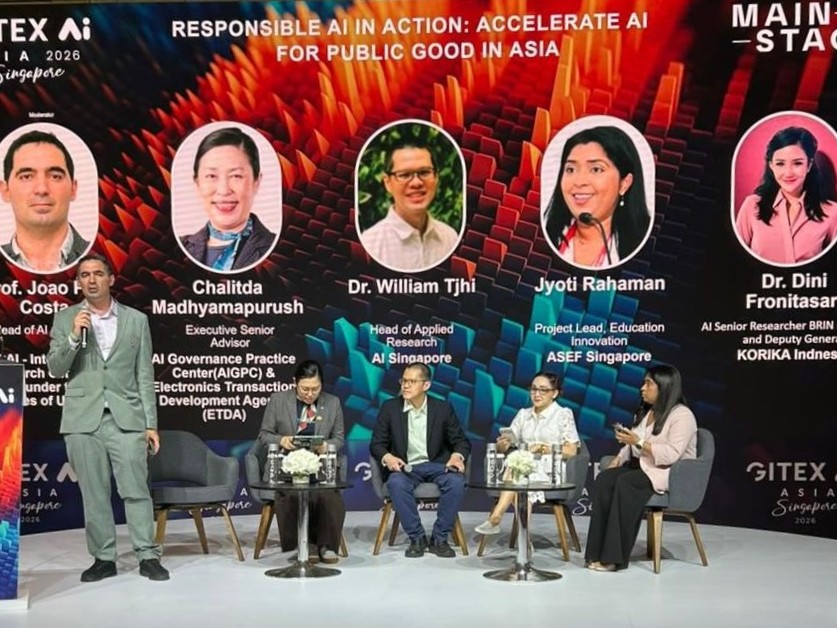
Accelerating Impact: The Main Stage Panel
An important discussion continued on the Main Stage on April 9 with the highly anticipated panel, “Responsible AI in Action: Accelerate AI for Public Good in Asia.” Moderated by Joao Pita Costa, the panel convened a dynamic group of regional leaders to discuss scaling inclusive, human-centered AI across the continent.
The distinguished panel of experts included:
-
Hammam Riza, KORIKA (Indonesia)
-
William Tjhi, AI Singapore, SEA LION LLM (Singapore)
-
Chalitda Madhyamapurush, Thailand AI Governance Centre (Thailand)
-
Jyoti Rahaman, Asian-European Foundation (ASEF) (Singapore)
From Pilots to Real-World Impact
The cross-sector energy in Singapore underscored a vital truth: transitioning from AI pilots to massive societal impact requires more than just technology. It demands trusted partnerships, local relevance, and an unwavering commitment to ethical AI.
ELIAS and IRCAI extend their gratitude to all partners, participants, and GITEX Asia for creating a dynamic space where global ambition meets regional action. The future of AI must be shaped collectively, and responsibly.